
Group show
Represented Artists
Guest Artists
To record is not to preserve; it is to accompany what is changing, to listen to what has not yet been spoken, to trace what has not yet found its form. Some gestures occur before language, as if matter, sound, or line could contain a thought that still doesn’t know how to express itself. Art operates in that suspended instant: not to fix, but to hold something on the verge of disappearing. Attending to what happens allows history and experience to resonate without demanding answers or closure. Each gesture, trace, or sound brings forth what is in transformation, letting art bear witness to what is still being written.
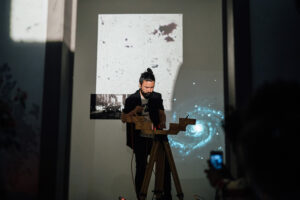
From that notion of what persists even before being articulated, the work of Jorge Barco explores deep listening. By submerging sonic devices into the waters that emerge from the Nevado del Ruíz volcano, what surfaces is not a landscape but a geological vibration—a voice of the territory prior to any narrative. His interventions do not describe a place; they allow the viewer to perceive a pulse before form, as if for a moment we could hear what the earth has not yet spoken. Rather than constructing a narrative, the work opens itself to a frequency that continues even after listening ends. Here, the artistic gesture lies in allowing oneself to be traversed by that flow.
If in Barco the attention arises from what has not yet been articulated, in Martha Lucía Ramírez it emerges from what was once meant to be fixed and now rearranged. In Cuadernos huérfanos (Orphan Notebooks), fragments of school writing are dismantled and reassembled with red stitching—a reference to correction pencils—that does not amend but rather binds together ages, writings, and memories. Writing becomes an act of rereading the past: it is not preserved, it is reconfigured. Approaching what was written becomes a way of caring for what transforms.
There are moments when attention shifts not toward the past, but toward the possibility of meaning. Daniel Valencia begins from the verb as the origin of thought, exploring language through tongue twisters, orality, nonsense, and identity-building. In his watercolors, the verbal game migrates into the visual plane; what once tripped the tongue now unsettles the gaze. Popular sayings, song lyrics, anecdotes, and orally transmitted stories operate as triggers that activate thought before understanding. His practice does not follow a logical sequence: it stumbles to reveal alternative ways of perceiving.
When language steers toward evocation rather than literal expression, the work of Natalia Mendieta emerges. In her practice, the word resonates more than it states. She recovers fragments of poems or reflections but rewrites them through gesture, erasing their literalness to allow each viewer to form their own reading. In her painting and collage, text becomes calligraphic, expressive, emotional; within its opaque layers and contained strokes lies a writing that renounces meaning so that something may manifest.
That superimposition between image and word takes yet another form in the drawings of Ana Patricia Palacios. In one, a female nude is accompanied by terms selected through a method akin to cadavre exquis, reflecting on duality and everyday life. In another, two former combatants sleep embraced on a bench, while in the background appears the handwritten lyrics of a rap song. Image and text do not correspond directly, but together they activate reflections on body, history, and memory. The word does not illustrate the image; it destabilizes it, opening it to what is left unsaid.
In Palacios, the relationship between saying and showing generates presence; in Fredy Clavijo, it arises instead through shared experience with the environment. His practice moves toward dialogue with materials and local knowledge: he works alongside artisans to foster an exchange in which utility becomes secondary and material culture speaks through making. His sketches and pieces are shaped by attentive listening to place and by hands-on collaboration with traditional trades. Here, the work consists in accompanying a collective process rather than capturing something.
That capacity of matter to contain ways of inhabiting finds a different path in the work of Juliana Correa. Her textiles do not imitate urban structures; they translate them through the lived experience of those who move through them. Each weave behaves like silent writing—less a description of the city than a suggestion of possible forms of life. In her textile practice, representation gives way to belonging.
If in textiles territory becomes a soft weave, in Víctor Muñoz language confronts the hardness of urban material. In the Medellín series, he perforates words into oxidized metal sheets. The city emerges through materiality: rather than an image, it manifests as temporal trace. The word, traversed by time, cracks, shifts, and remains in what survives. Echoing the legacy of Adolfo Bernal, the minimal intervention of language becomes a critical action; here, writing functions as imprint.
Only after passing through that material limit of the word does another possibility unfold in the work of Luis Luna. His reflection begins with the understanding of language beyond communication—as a territory of thought, a way of extending a hand toward the world to generate meaning. He extracts phrases from chronicles, poetry, or philosophical texts and displaces them from their context, turning them into graphic gestures that operate through resonance. Instead of fixing an interpretation, his work prompts movement in meaning, as if each word could rehearse its own thinking. In his practice, writing does not constrain—it summons.
What remains is not preserved intact: it vibrates in sounds, materials, words and gestures, in forms that allow us to approach what is still being written. Each work offers a distinct mode of attention, without imposing explanation or closure. What persists does not present itself as certainty, but as possibility: an open space from which to perceive, listen, read and, perhaps, continue imagining what is yet to come.
Ana Lucía Arbelaez Z
Selected images


-----> Sobre al artista <------
-----> Sobre los Artistas (Cuando son Dos)<------
-----> Sobre los artistas (muestra colectiva) <------
About artists