At the same time and in the same space, the processes of arrival and departure mark the daily moments of recollection. The journey to reach the other shore, and the ineffable return, are an endless meditation.
The present exhibit “Orillas” (Shores) proposes to think about the passing of time and the action of the elements over matter. Shore is a word that has no antonyms; at most, it is a mirrored line. The circularity of an edge reminds us of the uroboros, or the serpent that bites its own tail, as a metaphor of the cyclical and continuous nature of things, of the eternal rebirth, of the perpetual movement of the sea.
In the words of Maestro Luis Fernando Pelaez, the attrition of things is the matter of his piece. Light falls over the mountain, water flows from the mountain to the river, from the river to the sea, where the light is blinding. The river runs towards its destiny. The natural elements are the ‘landscapes of life’, the sun, the earth, the mountains, the waters. Everything is movement and process.
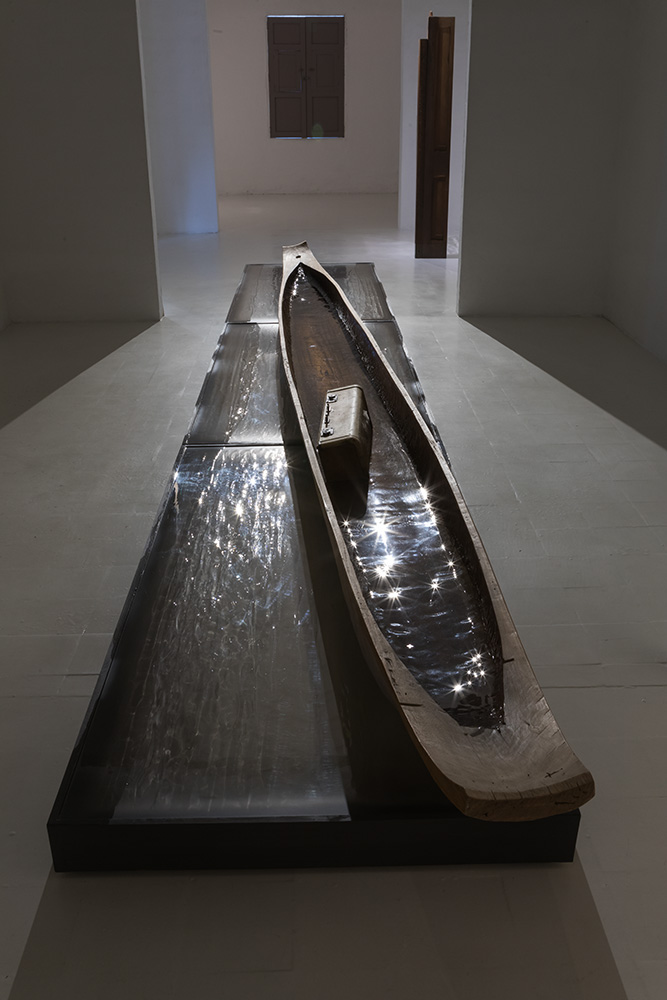
Light and shadows are projected on the floors, sculptures that speak of interiors of houses lived by others whose lives we are unaware of; the architecture of doors and windows point out the act of trespassing from an inside to an outside, or the mutation of spirit and matter to another state, or the journey from one shore to its opposite extreme. Light breaks through the clear planes and, with it, the rainwater insinuates itself as a veil. The veil allows us to glimpse the glimmer of light on the sleeping streams. It is revelation and concealment, a sign of the eternal instant.
It is the journey that never ceases. Through the waters we flow.
Neruda said:
“por arriba los trenes,
por abajo las aguas,
enfermos de seguir un largo viaje
que principia, que sigue y nunca acaba. Cielos arriba, cielos,
y pájaros que pasan
sin detenerse, caminando como
los trenes y las aguas”
Fresh mountain nights reappeared like memories of periods of life linked to the landscapes of youth. Mountains are mistaken with the memories that blossom with light when the sun sets, when everything is silhouette, chiaroscuro and the slow sundown of the evening traces a faint line on the horizon. It is the twilight moment; when the night opens its mantle of silence and obscurity. It is, in words of the Maestro, the moment to “collect parts of a time, signals of a traveler, days of the water and with those few elements, keep memories of a place that i turn is no place: everything has moved with a scorching force where only the wind, the big wind, leaves the trail of sands and leftovers and days in ruins, pieces of what was the kingdom.”
Three conceptual scaffolds characterize the work that Luis Fernando Peláez presents to us in ‘Orillas’.
Process
The idea of process marks his work in a specific way. The processual represents a category that provides instrumental thinking to organize knowledge derived from experience. Understanding the world as a process allows us to comprehend that things, such as material substances, are organized through the action of activities deployed in time and space. Matter is dynamic and changing; it is not a static thing like the The Enlightenment’s thoughts tried to understand it. Also, ideas travel linked in time. Memory as a human faculty mutates with the passing of hours and days, melting in ‘Orillas’ with an autobiographical and personal imaginary.
What is really the need to reinvent everything? The toolbox allows each object, each sculpture and each two-dimensional work to have its own identity within a well-defined and demanding set of notions around the journey that is life. In Luis Fernando’s work the world is not reinvented. It is observed and it is lived. Water, light, th journey, among other ideologies, give rise to a combinatory art, by means of which few elements, let's say, only the necessary ones, make up a poetic and personal environment where some concepts, as a toolbox, enclose universes of meaning.
Matter
In the coherence between matter and idea lies the weight and heart of the images. In the experience of fluidity and malleability, as of weight and density, arises the aesthetic experience of the work. Matter and ideas are indissoluble. For phenomenology, the origin of human knowledge parts not so much of scientific deduction as of experimentation through all the senses, matter, in addition to its retinal image, is felt as texture, form, gravity, weight. In the work of Luis Fernando Pelaez the materiality of iron, glass or wood and the production processes themselves emphasize the material that communicates ideas and feelings, through sensations that belong to the very root of the imaginative force.
Idea
‘Orillas’ does not seek to make a definitive statement. It is a scene to be thought of, a moment of transit in a creative process, a container of possibilities, a variable set that refers to timeless and universal concerns.
The trees shake under the rain. The smell of the earth emerges and a faint flash of light appears in the cloud. The path becomes a stream, a waterway that runs to the seaport where an aimless traveler awaits.
Ana Patricia Gómez. Bogotá, june 2021
Selected images


-----> Sobre al artista <------
About